

My deepest dream is the flourishing of the world. I want the world to be OK, and for the people I love and the earth to be OK, for all of us to be OK — to flourish, actually. I think this is a common dream, but a tender one we hide under fatalism.
I want to make this dream come true, but it’s an enormous ambition. Impossible for one person, I think I can flat out say that, though I don’t like to bet on the difference between possible and impossible. But there we have it: saving the world is no one person’s job.
But I can do something. I can make small havens. Places of flourishing and wholeness. Places where the dream sinks into us, has a texture and a scent.
These havens have real effects on people’s lives. I know because I have experienced havens other people made for me. The greatest moments of my education worked like that. They were small spaces made by dedicated people with big hearts and a big vision of what it meant to be a person. They were places where we were held to that vision, and where we soaked up that expansive humanity. They weren’t perfect, or eternal, but they made places where my whole self belonged.
I think this is the work inside my work: it’s what I, like so many people, am doing with my life. This is the deeper point of Frog Hollow (though learning to write is a good thing too!), and it is behind the obsession with utopia and chosen family in my novels.
We inhabit these temporary utopias, imperfect and bubbled as they are, to practice possibility — of ourselves, our relations, and the world — that we then bring in a diluted form outward into everything.
The longer I teach, the more I feel that the way we’re being in my class matters more than what we’re doing. The academics are the thing that gives us the reason to be there, practicing being human together. Not that the academics aren’t important, or exciting, or that I’m skimping on them, just that what I am after is creating a haven. Giving students what the schools I loved gave me.
This is how more than good schools work. Novels and poems work this way too. And gardens. Theater, music, parties. At their best, families give us these havens, and so do friendships and loves. A special restaurant can be one. A park can. Vacations and camping trips and festivals can. Some stores are havens to me, and I’ve seen workplaces that seem to act this way, at least at times. We can find haven in a summer camp, a potluck, a picnic, a song, a hug, a conversation.
I’m reminded of Audre Lorde’s line: Attend me, hold me in your muscular flowering arms, protect me from throwing any part of myself away. This could be a metaphor for havens.
These micro-cultures, relationships, moments, and discreet worlds bead together. I believe them to be powerful and life-giving, especially as they spill out into larger public life and daily routines. May we all have lives thick with them. May we open them to include others.
And of course, of course, these havens aren’t perfect. They’re human. I think that’s the point. They are spaces we can be more fully ourselves, places we can be whole, which means sometimes being messy. Hopefully (crucially) they are also places where we bring integrity and curiosity and breath and whatever other tools we have, so that we can do them well.
This is challenging, for sure, and my classes are certainly works in progress. But when things feel right, in the class as a whole or in an interaction with a student, I think we’re living that flourishing.
In my experience, it’s better to do a small thing with integrity than to have a big vision you enact with power plays or shadiness. This is one way haven-making goes astray.
Things are also ephemeral, which is also painful. I know that one of the bitterest things is when our havens fall apart or we see them hacked down. I wish I could just wax enthusiastic about the joy of being in a place our whole selves belong without mentioning the pain of their loss. But there it is. The loss is possible, possibly inevitable, possibly nearly unbearable, and still the havens are worth it. Like living is worth one day dying, I guess.
I’ve been thinking a lot this spring about this quote:
“Imaginary evil is romantic and varied; real evil is gloomy, monotonous, barren, boring. Imaginary good is boring; real good is always new, marvelous, intoxicating.” ― Simone Weil
I’ve been wondering if it holds true to flip it around: that if something is gloomy, monotonous, barren, and boring1, it might just be a bad thing. If, in other words, internal delight can be a moral compass. I say yes.
It also makes me think of something I learned about nutrition a long time ago, which is that what tastes good is good for us. If there are, say, two carrots, and one tastes crisp and sweet and the other is woody and bland, the delicious one will also be more nutritious. There’s a distrust of this, of being able to eat what is delicious, because of the pleasure of junk food, I guess. But I think that we can listen past that and it still holds true. A deep red wild strawberry tastes good in a way a candy bar just doesn’t. It’s a different kind of delicious.
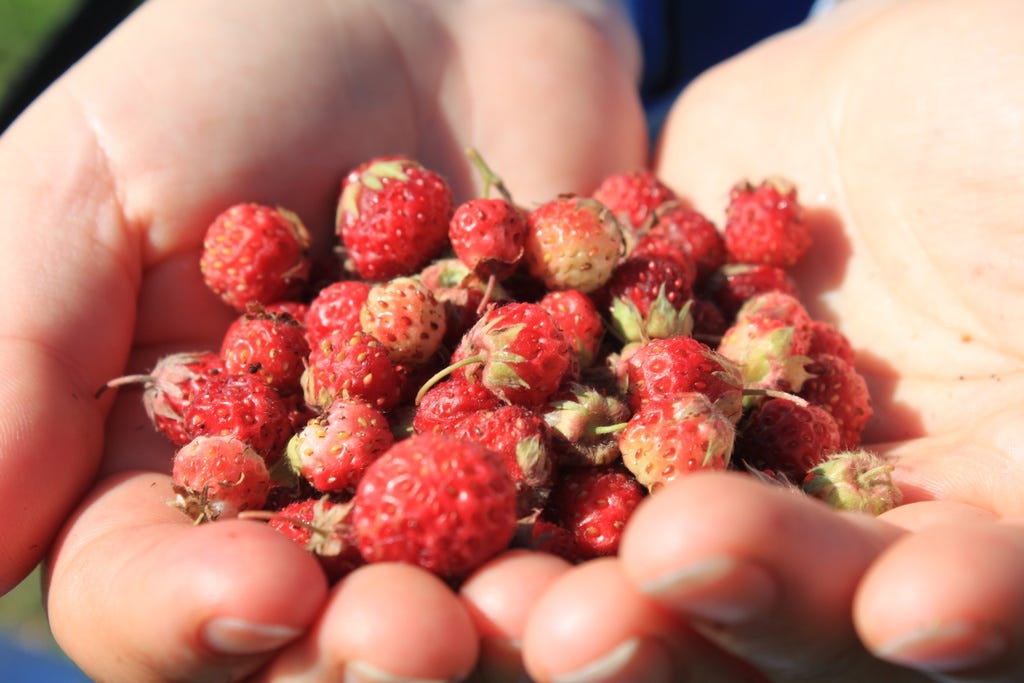
What does this have to do with havens? This same kind of delight-compass seems to me like a big part of knowing if you’re making a healthy human space, or if you’re in one.
My work is tiring and chaotic and sometimes we get through the day by the skin of our teeth, but at the heart of it is delight. There’s the nerd-delight of sharing ideas, the poet delight of encountering wild and wonderful things in the children’s writing, the teacher delight of watching their hard work and their delight, and the human delight of being a group practicing kindness and respect and having fun together.
So that’s one haven. This orange velvet chair I write in is another, a chair that was a gift to myself. Squinchy’s companionship and dreaming breath has been a deep haven for me for fifteen years (less so his terrible dog farts and breath2). So many more, and the beautiful thing of course is that we make them for each other and inhabit them together and so we live.
Or gold-plated.
My students in their group exaggeration poem last year: “Squinchy’s breath is so bad other dogs smell his face instead of his butt.”